Assumption #3: Democracy is good, monarchy is bad.
Shame of me for having this assumption in the first place. Mrs. Mirkow, dear Mrs. Mirkow, my 11th and 12th grade history teacher first lesson in class - I remember it like it was yesterday - instructed us to throw out all our western-centric ideas that go as follows: we are in a democracy, it works well for us, so others should follow us so they can become better.
However, over my past 3 years of Poli Sci schooling at UNC and Duke, I've had the idea that democracy is the be all and end all crammed down my throat. I've learned much about how a vibrant and active democracy it is supposed to promote peace, free trade, more sustainable & equitable development, less hunger and many other desirable traits such as have a representative government.
Two things have given me pause over the last few years however. First, that some things about democracy just plain suck. By this and I'm sure many of you feel the same way, among other things, the campaigns and media coverage thereof are ridiculous, often about style over substance, are sensationalist and rarely narrow their focus on the real nuts and bolts issues of what's important to a country. The incumbency rate is unbelievably high and politics - in America at least - seems to be more about how much money you have, who you know (and how much money THEY have) then about merit or vision. I've heard that people are predicting the 2008 presidential campaign to be the first campaign where candidates combined spend over $1 billion on expenses to win the White House. Well, at least Rupert Murdoch is happy.
Once in office, it doesn't seem to get much better. The mountains of bureaucratic-inertia are often stifling and what gets done isn't always a whole lot better than doing nothing. While The Daily Show does a fantastic job of finding and exaggerating every single ridiculous debate, rider amendment and pork-barrel spending to make it seem like this is ALL they do, it definitely seems to happen way to much as it should considering how great democracy is supposed to be.
Don't even get me started with lobbyists.
Secondly, democracy seems like it needs to much more that a system or series of
elections or new story but rather a culture and way of life. More importantly, for
democracy to work, the society that suits it. By this I mean it must have an independent and free press to be able to verify and hold leaders accountable as well as inform the public about what is going on. There must be a thriving civil society with businesses, community groups, NGOS and other interests groups so citizens can come together to lobby for their rights. There must be stable and multiple political parties so that individuals have viable alternatives to choose from if one party doesn't carry through on its promises. The democratic system must be designed in a way that suits the country's demographics. Finally, the people in the nation must at a state where they can participate. Yes, that means willing. But this also means not hungry and impoverished, with a job, educated, and not fearful for their lives because of violent conflict or insecurity.
As the French would say, "c'est pas evident" - its not easy/simple. It is these sorts of democratic enablers that Iraq lacked and is the reason that the idea of imposing democracy with the sword made and stills makes absolutely no sense. Don't get me wrong though, I think democracy is a fantastic tool. However, I do think it is one that a country must be ready to use. It is at this point that I find myself between two conflicting quotations - first, that democracy merely is "tyranny of the majority." And second, that democracy is "the worst system except for all the others."
I certainly believe that if given the choice between any given country to be either a democracy or at the whim of a random autocrat, I would certainly choose the former. However, Morocco, in particular, isn't faced with this choice.Instead, Morocco is a "democratic, social and constitutional Monarchy."
The first things one of my colleagues noted is that democratic monarchy is about as oxymoronic as it gets. In spite of this, Mohammed VI, the King, has made considerable reforms during his tenure. Provding more political and social freedoms, rewriting Morocco's antiquated family code to give women unprecedented legal rights in the Arab world and focus on poverty alleviation and housing as two of his major policies.
Hearing about this brings "benevolent dictator" to mind, which many see as the ideal form of government, if you can assume he (or her...ok he..jk) will remain this way and is motivated to be efficient in being benevolent. But it is this that gives me pause. In a democracy, there are tangible incentives for doing good, for improving the lives of your citizens: your job. If you don't produce results, you get the boot. But for dictators, unless you really terrorize your people so that they revolt against you, all you really have to do to keep your job is keep your inner circle content.
Yet, in applying my democratic education to Morocco, I've found my initial assumption - that Morocco would be better off right now with a full democracy (ie no King or a king like the UK has one) by some of the conversations I've had. Instead, it seems that what he's doing - promoting economic and social development while engaging in the process of democratization gradually and still remaining a unifying force is a pretty good step.... for the mean time. According to many I've talked to Morocco is not ready for full democracy with, for instance almost 1/2 of the population illiterate and many still in poverty and with voter education and party development still lacking.
However, is not clear cut. When South Africa held elections in 1995, it was still a very poor country. Yet, it was privvy to a unique period of unity behind Mandela that Morocco has not experienced. That doesn't mean that SA doesn't face huge democratic challenges today. SA, on the other hand, also did not have the option of a gradual transition from benevolent dictator to democracy. It is possible that with a full democracy here, the government would not be stable enough to do the hard work that must be done. The NGO I'm working with here, NDI, and many others NGOs are working with political parties, young leaders and the electorate to promote a more effective democracy. One thing I want to learn more about - and eventually write my thesis on (I think.....uggh I don't even want to start to think about my thesis) is democratic transition, how you cross the point of no return from autocracy to democracy.
For the moment, however, the King seems to be on the right track. He is providing more and more press, civil society and democratic freedoms while pushing for social justice. I only hope he continues his current reform and trend towards increased democratization and social development and, eventually, has the humility to ease gently out of the spotlight and let a thriving democracy, with all the benefits, and, yes, shortcomings, take center stage.
Unsurprisingly, it seems Mrs. Mirkow was right...she has always been there watching over me...
Tuesday, June 26, 2007


Monday, June 18, 2007
Assumptions Part 1
Assumption #1: I know my way around Rabat
Maybe others have had similar experiences or maybe its just because I'm a guy and a) don't like to ask for directions b) like taking shortcuts c) and c) like to pretend like I know my way around somewhere even if I really don't have a clue where I'm going, but in my life I have found that the second that I think I've figured out how to get around a city, I get horribly lost. This happened to me going home from work the other day - I just simply wasn't paying attention and found myself walking up the wrong street. Any normal person would have turned around, walked back to the junction I knew and find the right street. I, on the other hand, thought I could cut my losses by taking a short-cut. I would soon discover that this would only add to them.
Luckily for me, I was able to use my French to communicate with some nice folks and got myself in the right direction, eventually, a stable, forest and a few tennis courts later. Then, I was lucky enough t o have my family friend see my walking the street and be nice enough to turn the car around and pick me up. In sum, I'm a lucky guy. What this experience did make me thankful for was having my French. Being in Morocco - even more so than France - has made me sympathetic to those travelling to lands where they don't speak the language. I'm thinking about those Asian tourists I see clicking photos around DC. Just like me trying to read an Arabic sign - I can't even begin to pronounce it! - the letters that your reading right now look like Greek to someone from Japan, or from Morocco for that matter, who hasn't had any schooling with them.
While French is around most of Rabat and I can get along just fine with it, especially in upscale or touristy places that cater to foreigners or local frogs or events targeted at a wider audience such as the recent Jazz festival, Arabic is the language of the street. When i take the bus to work every morning, I notice very little French and a whole lot of Arabic. Being in that environment and speaking ore or less no Arabic has reinforced the idea that not speaking the language that's around you is an isolating, difficult and frustrating experience. It's something you don't even notice in others around you when you speak the language of the place you're in, but when you have something you're dying to say and you just have no idea how to express it using gestures (and contrary to popular belief speaking the language you know REALLY LOUD won't communicate the message either), it is irrepressibly frustrating.
One of the places I've had more trouble than I expected is in whats known as Petit Taxis here - small, cheap taxis that cost about 2 bucks to go anywhere in town. Having a few drivers who barely speak any French has left me feeling distant and in a different world that the driver. For a moment, I almost started to get irritated that the driver didn't really speak French, a language I had hoped would allow me to communicate with everyone. However, I was able to take a step back and realized that Arabic really is the language of this country, not French.
What I also realized was that I was not really as irritated by the fact that he didn't speak French than by the fact that I don't speak Arabic. I always enjoy knowing enough of a language for simple pleasantries, to be able to ask questions about a person in their own language and, of course, to be able to say "I speak a little of X language" or preferably "I'm trying to learn X language, but its not going so well!". Yes, for the selfish reason of wanting to communicate to people but also to convey that I have at least made some effort to meet the other halfway - well not quite halfway, maybe 1/100th of the way.
This brings me to the next assumption...
Assumption #2: Arabic is Arabic

"Mbtekti arabi shwia" or so I thought. This, of course, means I speak a little Arabic in Arabic. But, as I pulled this expression out as I talked to a storekeeper, all I received was a blank stare. At first I thought it was just horrible pronunciation. It turns out this was PART of it, but I also learned that while this might be "I speak a little Arabic" in Classical Arabic, it doesn't really mean all that much in Moroccan Arabic.
To back up, I thought a good way to learn Arabic was to get an Arabic audio lesson so I could have the basics of Arabic . I remember vividly one of the examples used "I am not Syrian, are you?" I probably should have taken that as a hint that it might not fly. It turns out that most Moroccans can understand classical Arabic, but its not a good way to communicate.
What's interesting though, is that Derija, the Moroccan slang dialect, is a blend of Moroccan Arabic, Berber (Moroccan rural language) French and apparently some Spanish too. As I hear my colleagues and friends talk it, I can understand just about every 9th or 10th word, usually filler words like "tu vois" and "en fait" (you see and in fact). They don't help all that much with comprehension, but they are an interesting indicator of the history of this co untry and the diverse influences that shape what it is today.
Next step, learn a enough Moroccan Arabic to get by. Wish me luck, j'en aurai besoin! (I'll need it!)
P.S. All these signs are helpful to know, the first is "Truck Exit" and the second is "It's strictly forbidden to cross the tracks" - good thing I speak French! The third obviously means "Protect the Grass" (I had to have it translated)
Maybe others have had similar experiences or maybe its just because I'm a guy and a) don't like to ask for directions b) like taking shortcuts c) and c) like to pretend like I know my way around somewhere even if I really don't have a clue where I'm going, but in my life I have found that the second that I think I've figured out how to get around a city, I get horribly lost. This happened to me going home from work the other day - I just simply wasn't paying attention and found myself walking up the wrong street. Any normal person would have turned around, walked back to the junction I knew and find the right street. I, on the other hand, thought I could cut my losses by taking a short-cut. I would soon discover that this would only add to them.
Luckily for me, I was able to use my French to communicate with some nice folks and got myself in the right direction, eventually, a stable, forest and a few tennis courts later. Then, I was lucky enough t
 o have my family friend see my walking the street and be nice enough to turn the car around and pick me up. In sum, I'm a lucky guy. What this experience did make me thankful for was having my French. Being in Morocco - even more so than France - has made me sympathetic to those travelling to lands where they don't speak the language. I'm thinking about those Asian tourists I see clicking photos around DC. Just like me trying to read an Arabic sign - I can't even begin to pronounce it! - the letters that your reading right now look like Greek to someone from Japan, or from Morocco for that matter, who hasn't had any schooling with them.
While French is around most of Rabat and I can get along just fine with it, especially in upscale or touristy places that cater to foreigners or local frogs or events targeted at a wider audience such as the recent Jazz festival, Arabic is the language of the street. When i take the bus to work every morning, I notice very little French and a whole lot of Arabic. Being in that environment and speaking ore or less no Arabic has reinforced the idea that not speaking the language that's around you is an isolating, difficult and frustrating experience. It's something you don't even notice in others around you when you speak the language of the place you're in, but when you have something you're dying to say and you just have no idea how to express it using gestures (and contrary to popular belief speaking the language you know REALLY LOUD won't communicate the message either), it is irrepressibly frustrating.
One of the places I've had more trouble than I expected is in whats known as Petit Taxis here - small, cheap taxis that cost about 2 bucks to go anywhere in town. Having a few drivers who barely speak any French has left me feeling distant and in a different world that the driver. For a moment, I almost started to get irritated that the driver didn't really speak French, a language I had hoped would allow me to communicate with everyone. However, I was able to take a step back and realized that Arabic really is the language of this country, not French.
What I also realized was that I was not really as irritated by the fact that he didn't speak French than by the fact that I don't speak Arabic. I always enjoy knowing enough of a language for simple pleasantries, to be able to ask questions about a person in their own language and, of course, to be able to say "I speak a little of X language" or preferably "I'm trying to learn X language, but its not going so well!". Yes, for the selfish reason of wanting to communicate to people but also to convey that I have at least made some effort to meet the other halfway - well not quite halfway, maybe 1/100th of the way.
This brings me to the next assumption...
Assumption #2: Arabic is Arabic

"Mbtekti arabi shwia" or so I thought. This, of course, means I speak a little Arabic in Arabic. But, as I pulled this expression out as I talked to a storekeeper, all I received was a blank stare. At first I thought it was just horrible pronunciation. It turns out this was PART of it, but I also learned that while this might be "I speak a little Arabic" in Classical Arabic, it doesn't really mean all that much in Moroccan Arabic.
To back up, I thought a good way to learn Arabic was to get an Arabic audio lesson so I could have the basics of Arabic . I remember vividly one of the examples used "I am not Syrian, are you?" I probably should have taken that as a hint that it might not fly. It turns out that most Moroccans can understand classical Arabic, but its not a good way to communicate.
What's interesting though, is that Derija, the Moroccan slang dialect, is a blend of Moroccan Arabic, Berber (Moroccan rural language) French and apparently some Spanish too. As I hear my colleagues and friends talk it, I can understand just about every 9th or 10th word, usually filler words like "tu vois" and "en fait" (you see and in fact). They don't help all that much with comprehension, but they are an interesting indicator of the history of this co
 untry and the diverse influences that shape what it is today.
Next step, learn a enough Moroccan Arabic to get by. Wish me luck, j'en aurai besoin! (I'll need it!)
P.S. All these signs are helpful to know, the first is "Truck Exit" and the second is "It's strictly forbidden to cross the tracks" - good thing I speak French! The third obviously means "Protect the Grass" (I had to have it translated)
Tuesday, June 12, 2007
A Land of Contrasts

I had previously read about Morocco's important geo-political role. As an Arab nation, it is the most advanced democracy among them, the most modern and the most likely to embrace an inclusive notion of globalization. While Iraq is where the battle between the modernism and fundamentalism is taking place with guns, Morocco is on the forefront of the ideological battle, seeking to modernize and adapt while also sensing the Islamic revival that has emerged in the past couple decades. I heard that Morocco can be seen as a sign of things to come for west-east relations. If Morocco allows modernism and tolerance to overcome extremism and bigotry, it portends good things.
I've had many experiences that testify to the struggle in this country that I had read about. However, I have also been humbled by how much I did not expect, both in the ways Morocco is still tied to the past and the ways it is embracing the future, and by those small things you just cannot prepare yourself for. This is really the first place I've ever been where I've faced Islam and Arab culture head on so I've had a number of firsts: fully veiled women, a taboo against alcohol, Mosques where non-Muslims are prohibited from entry, gyms segregated by sex. By the last thing, I do not only mean that you have men's gyms and women's gyms with different focuses etc. Instead, there are gyms with hours or days for each sex so that each gender has a single-sex workout environment. I could never imagine this in the US so you can imagine my surprise when I first was made aware of this by the gym receptionist. Morocco seems to be full of contrasts, a place where where one of the biggest issues of our shrinking world, traditionalism versus modernism, is ever-present, juxtaposed and divisive.
One example of this contrast is the culture of drinking here. It's something I've struggled to get used to, particularly coming from France where anyone and everyone past infancy has a glass of wine or two with dinner. While alcohol is technically forbidden by the Koran, this does not mean that Muslims do not drink. Instead, there really is a variety of the way people interpret this: some have a glass of wine, some don't, others have about ten of them. Like some of the Southern US, there are attempts made to keep alcohol on the down low. For instance, at the local supermarket ,there is a separate subterranean (it is technically underground) floor devoted to alcohol. With wine, beer and everything it was an alcoholic's paradise. As you check out, they go to great effort to hide the contents of your bag. They are dark black and they double bag it - tying the first bag off. Interestingly, I didn't notice a single female client there.
Another example of the modernism/traditionalism contrast is the below picture .
 Right outside the main square in Marrakesh, about 4 hours SW of Rabat, a teenager was selling this toy. which was an electric train with two parts: our president, Dubya, on a tank with its barrel pointed at Osama Bin Ladin in the car in front of him. As I'm sure was the intention, Dubya and him go around and around in circle, with W never catching him. In a country where most people strongly dislike Bush, this product is being marketed to tourists, representing the modern capitalistic influence, promising to share the better standard of living shared by the western world. Meanwhile, the omnipresent symbol of traditionalism, Osama, is very much a part of this picture, providing the dramatic chase and fighting against the values that tourism - and Bush - represents.
I encountered this again when talking to a local shopkeep in the Medina (or old city) in Rabat that I have gotten to know. He argued two things. First, that the only thing coming between the US and the Arab world is Israel Palestine, saying that is solved tonight, Americans and Arabs would be dancing arm-in-arm. Second, that Bush is the same type of person as Bin Laden, just the other extreme. Bin Laden offers complete traditionalism with the destruction of the US and what it represents and Bush offers the opposite.
One stereotype that has proven true is that no one likes Bush in Morocco. Once, I even had a taxi driver ask me what I thought about Bus before he'd let me out of the cab. While I have been here for the summer and during the last four months in France, for that matter, I've often found myself sympathizing and agreeing with the pretty significant disdain for Bush, as I did with that cab driver. Yet, I've also occasionally - and grudgingly - found myself defending him. I've not really made an attempt to defend what he's done but more-so his intentions. Besides some of the arrogance and belligerence he's shown, I believe he has had mostly good intentions. For instance, my work here, promoting democracy, is something he's stood staunchly behind. I do commend him for this but I also remember that this is exactly what he was doing in Iraq... When thinking about Iraq, I remember my country too contains some of the same contrasts and hypocrisy I've run into in Morocco. Bush does represent a kind of extremism that does delegitimize some of the good work being done to promote democracy that NGOs such as NDI are doing. While Osama clearly is much more extreme, his presence too delegitimizes a cause that does have some merit, preserving some of our traditional values in light of a world that is rapidly changing, yes, often for better but, occasionally, also for worse.
Yet, It seems like the media sensationalizes and distorts reality by over representing these extremes. As Jon Steward says, the media only talks about the trucks that are on fire. I've been amazed by how mixed these two "worlds" are . I imagined a deeper separation
 but I've encountered a blend of traditionalism and modernism in many parts of daily life. Unlike the impression I got from what I've read or seen in the media, these aren't always in conflict. One of my friends cares for both mixed drinks and Allah. I asked if he thought this was a contradiction and he said not at all. Instead, just like Christians who do not follow all of the instruction of Leviticus, he said that he has his interpretation of what's important just as others have their. Taking to him, I realized that I have a lot to learn about Islam and the role it plays in the lives of those who follow it. Just as Christians are a motley crew, so too the Islamic world is full of contrasts. That is something I hadn't really begin to understand until I got here.
I also realized I did not understand what the contrasts of this nation really meant. I had in mind the deadly results of extremism and modernism clashing symbolized by the Casablanca bombings in 2003 that killed more than 40 people. However, such explosive events have seemed to be the exception, not the rule. Instead, Moroccans of all beliefs have lived together in relative peace in spite of their "contrasts". Thanks to this, baseball caps are seen next to veils, the sound of the call to prayer are heard along side the sound of merchants selling socks (made in China, of course), Coke is sold along side of The a la Menthe (traditional Moroccan mint tea) and tradition and modernism are able to live side-by-side.
Wednesday, July 05, 2006
Out of Touch!
So if you feel I’ve been a little absent recently in cyberspace, you’re right. We have been out in the rural Eastern Cape
We flew into East London, a small town a hundred km or so from  There we stayed at a small backpackers situated on a beautiful beach. We got to hang out there for a couple days before the back breaking manual labor commenced. Just kidding, well, kind of.
Then we drove a couple hours to a TINY village named Tuku. There we were welcomed with open arms by the villagers. They seemed excited to have us there and show us their beautiful hamlet of a town. We stayed with home stay families, mine was fantastic. There was a lot of estrogen – a grandmother, her daughter and 4 grand daughters – but I could deal with it. It was fantastic being out of the city which allowed us to see the stars at night and be waken up – much to our dismay at about 4 A.M. but the roosters perfectly situated outside our window. It wasn't exactly luxurious; we washed in a bucket and didn’t have running water. Yet the family’s warmth more than made up for what it lacked in accommodations
Our task in this town was to fix up a forsaken school in complete disrepair.  Apparently the government isn’t into fixing up old schools, merely building new ones…it showed. We spent three days sanding, painting, and trying to fix broken panes of glass… the works.
From there we came back to the backpackers and spent a few glorious days lying on the beach, body surfing and tanning (read turning my body from white to pinkish-red). We took a plane from there to Joburg, where I am at the moment.
Now we are just finishing up a quick stop in a backpackers by the airport before we start a loooong drive to
If I have in fact been eaten by a lion, honor me, please.
Wednesday, June 21, 2006
Oh the minibuses
You learn a lot about people by the way they travel. Tell me about your new H2, Hybrid, mountain bike, or walking shoes and I can already make judgments about the kind of person you are. In Cape Town, one of the most popular form of transit is the minibus. These are basically big VW Microbuses with enough seats for 14-16 people. When you cram people in, as they always do, its more like 16-18.
I am a huge fan of the minibuses. Yes, they aren't always comfortable. Yes, the drivers drive like madmen, disobey just about every traffic law, and most drive minibuses that aren't exactly - let's call it - well maintained. In spite of this, however, I love riding on them. First all they make so much sense. Each ride is about 60 cents to a dollar, they go across main streets and to townships, you just flag them down to get on and say "enkosi driver" (thanks driver) to get off.
Being jammed in with people is a double edged sword. First you expect it so its no big deal. Second, after our American notions of personal space, one must quickly abandon this if you want to get anywhere fast. Unlike American transport, there isn't a fare box and anything like that. Sometimes there's a guy with a bag of change and everyone just passes their stuff forward. Everyone helps out getting people the right change and all. I also enjoy the lack of personal space because it reminds us of how sheltered we get in America, especially in public places. We have this image of everyone wanted their own privacy that rarely do strangers strike up conversations.
I don't know about you guys, but I love those random chats with strangers. The minibuses are perfect places. It's just amazing to meet people and hear about their views and life. Also, people on the minibuses are soo willing to help people out. You really feel the communal nature of the country. For instance, one time I was riding back to Observatory and I didn't know the cross street, so I was frantically looking outside the foggy windows for something that looked familiar. Suddenly, without me asking or soliciting his help, this nice guy asked me where I was headed (in English, goodness knows how he picked me out as a tourist) and told me where to tell the driver to stop. I don't think something like this would take place as often in America. There people are very willing to help when you ask. But our notion of individualism and minding our own business prevents a lot of human to human interaction and helping.
A few times I've yelled to the driver to stop but b/c I was in the back he didn't hear. People closer to the driver told him to stop. They didn't do it because I asked or because they had any interest in me getting to the right stop.
Another time, in line for the minibus to Langa, some lady asked me very nicely"ummm are you in the right line, because you know this minibus is going to Langa. Again this was without my prompting but she was trying to be helpful and make sure I got to the right place.
Another ride, I started talking to this woman next to me in isiXhosa and all these ladies around got so excited that I was learning and speaking isiXhosa very, very poorly.
The minibuses just reflect a lot about the culture here. It's communal and you share a lot (in some cases 3 seats between 4 or maybe 5 people). It's something that I think American culture can learn a lot from. So, to everyone reading, promise me next time you're in public transit, you'll lean over and ask the person next to you how there day is going or some trite comment about the weather. It might just be small talk but it's some of the smaller human to human moments that remind us how connected we are (or should be) to each other.
As always, comments are welcome,especially stories or interactions on public transportation.
Monday, June 19, 2006
Escapism, for better or for worse?

There are two types of vegetarians.
There are the quiet, "I just don't like the idea of eating meat" for whatever guttural reason (pun intended) type and mind their own business.
Then there are the militant "I'm morally opposed to being vegetarian to such an extent that I will disregard the boundaries between my stomach and yours to make sure every ounce of pleasure that that oh-so-supple pork chop supplies is completely annihilated the mounds of guilt I will heap upon you for participating in the circle of life, you souless bastard."
After 3 weeks of a pretty intense learning experience at our township home stays, this weekend we had the amazing opportunity to go to Cederberg, a secluded nature reserve about 4 hours drive north of Cape Town. It is a place far from most of modern man's influence, for better or for worse. Honestly, it was a more than welcome reprieve from seeing some of the worst of modern man's influence: the segregation, the poverty, the desperation, the insecurity in Langa township. It was more than welcome to wake up to the sunrise over a beautiful lake surrounded by sparkling red rock instead of that very same sunrise over teetering one room shacks. What was welcome was an escape from the realities of our imperfect world.
In Cederberg, we were privy to a landscape of
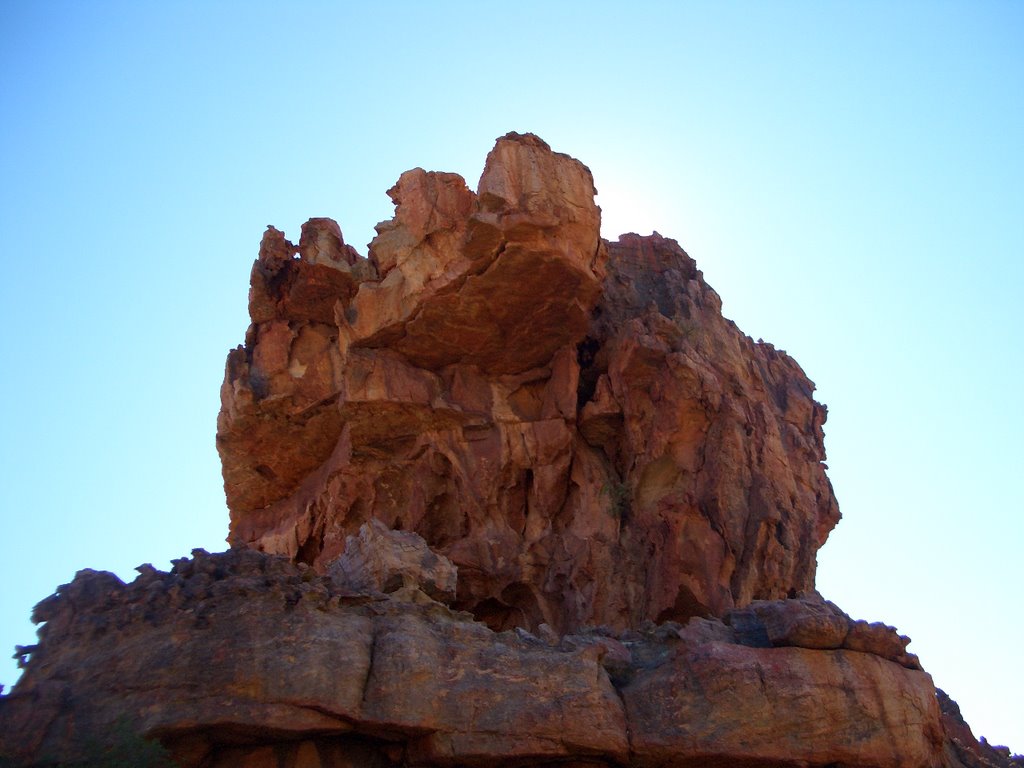 immense natural beauty. Saturday we hiked through a Mars-like red rock landscape (that is, if I mentally erase the trees, brush, birds...and water...well pretty much everything except for the rocks). Our day trip ended by a ...let's call it refreshing25 ft jump into a freezing river. It was certainly enjoyable but I'm not gonna lie, after I hit that bitterly cold water, I imagined those Martians had life pretty good on Mars without water...
Anyway, Friday and Saturday nights we (and by we, I mean Zed, our group leader) cooked out. Sitting out in the crisp, beautiful nights with good friends and good food, life seemed pretty simple. Strolling under the many stars that filled the night sky unpolluted by articficial light was something I particularly enjoyed. I feel very humbled looking up at the stars. It reminds me not to sweat the small stuff; seen from any of those stars in the beautiful expanse of our universe, complaints about imperfections in our lives and petty arguments seem insignificant, to say the least..
While you should have already drawn the connection to vegetarians, let me explain the link in my twisted mind, if you will indulge me. The striking juxtaposition of untouched natural beauty in a land of so many problems is not something I had to go to Cederberg for. I saw it on (or rather around) Table Mountain. I saw it in the beautiful tourist beaches in camps bay. In Cederberg, however, the contrast was so much more vivid because it was a trip specifically designed to get away from it all.
In everyday life, however we make efforts to get away from our problems. The oft used phrase out of sight out of mind seems to fit this build. I so often do my best to stay on the "right" side of the train tracks because it is so much easier to not confront the poverty of DC, for instance. My beautiful, mainly white middle-upper class corner of NW DC sure is an escape from the poor SE corner. The difference, however, is that this is a pretty permanent one.
However, the question that those vegetarians lead me to is where the balance lies between truly enjoying the finer points of life and remembering all the injustices and inequities of the world? Should your knowledge of the outside pain and suffering spoil the taste of escapist pleasures? Are those who relentlessly remind us of all that is wrong with the world ruining the wealth many enjoy? Are guilt tripping vegetarians are evil as I put them out to be?
Ubuntu is a culture in African communities that asserts that all human beings are connected and reminds us of our responsibility to treat everyone as a brother and sister. Certainly, there is nothing wrong with retreating to a simpler less worrisome life. I just think we, myself included, need to be sure to remember that there are those who do not have the option of retreat. They must be battle ready and charge in the face of injustice every day.
We must remember that as we escape from some of the realities of our planet, our sympathy, empathy and sense connectedness to those less fortunate should never be allowed to escape us. Most importantly, we must make sure we acknowledge that we are escaping from the realities of the planet. Cederberg was a retreat but an acknowledged one.
So yes, you can enjoy your lamb shank or pristine waters and crimson rocks over cloudless blue skies. Just don't forget where these opportunities came from and just because they are away from the realities of the Townships and heart-less meat-packing conglomerates, they certainly are not connected to them.
Wednesday, June 14, 2006
A different kind of life...
Poverty is something I have read about. It is something I have seen on TV. It is something I have discussed passionately. It is not, however, something I have ever experienced.
In my homestay, I certainly have had this experience. Certainly not myself. I still have my ATM card to fall back on. Yet, Langa -- one of the richest townships in South Africa -- is a very poor place. My family is very well off by Langa standards. We have a TV, stereo, dog, washing machine (no dryer though), an old Mercedes -- hell we even have a fishtank! Yet, money is not something that flows freely in the house.
Two examples come to mind. First, our mom has said she has a tough time sending her cute granddaughter, Sinu, to preschool because its experience. "How expensive is it?" I ask. Oh 80 Rand per month. For those not up on the daily Rand-$ exchange rate, that's about $12. It has been pretty depressing comparing that to my daily spending.
That's about a good sit-down lunch.
That's about four drinks at a pub in downtown Cape Town
That's about 1/2 and ounce of cocaine... just kidding -- but you get the point, it's peanuts in my books. In fact about 2 bags of them at a ballpark.
Example two is ice cream. Mama one day mentioned she liked Ice Cream. So, being a good guest I went out and bought her some. As the container was nearing its end, I asked Mama to remember me next time she eats ice cream. She didn't, however respond with the standard sarcastic OK. Instead she said "But what if I can't afford it?"
I had no answer.
Living a poor life makes you more creative. Once something is broken or you find you don't have something, you can't just by a new one. That is what we do in the States and I certainly have taken this freedom to buy more or less whatever I needed for granted. Yet, the tattered clothes, the poor dog's torn and broken dog house are testament to this lifestyle.
This weekend, I also was taught a lesson by a kid of about 10. Cooper and I were outside trying in vain to teach Sinu to kick a soccer ball. We soon realized that 3 years old might be a little early. But, some kids came along and wanted to play with us. They suggested we start a game. I thought this was a great idea. In my mind I wondered how far the nearest soccer field is or where I could get cones for goal posts. Little did I know the kids were already making the field. The sidelines were the sidewalks and the goals consisted of 4 well placed bricks. They didn't need a fancy field or even a wide open park to have a good time. They made do with what they had even far away from the grip of materialism.
I've been learning a lot in my homestay, perhaps the most valuable lesson is the value of experience. I have felt this before in my international travels and living. Yes, it is great to study something academically. Yet sometimes, you just need to live like someone to really understand their point of view. As one of my all time favorite books says:
I would love to hear comments and advice on how to balance trying to experience the lives of those who are disadvantaged while at the same time having many comforts to fall back on that these disadvantaged people just don't have access to. Can you really emphasize with people if you haven't really lived like them? If not, is sympathy enough?
In my homestay, I certainly have had this experience. Certainly not myself. I still have my ATM card to fall back on. Yet, Langa -- one of the richest townships in South Africa -- is a very poor place. My family is very well off by Langa standards. We have a TV, stereo, dog, washing machine (no dryer though), an old Mercedes -- hell we even have a fishtank! Yet, money is not something that flows freely in the house.
Two examples come to mind. First, our mom has said she has a tough time sending her cute granddaughter, Sinu, to preschool because its experience. "How expensive is it?" I ask. Oh 80 Rand per month. For those not up on the daily Rand-$ exchange rate, that's about $12. It has been pretty depressing comparing that to my daily spending.
That's about a good sit-down lunch.
That's about four drinks at a pub in downtown Cape Town
That's about 1/2 and ounce of cocaine... just kidding -- but you get the point, it's peanuts in my books. In fact about 2 bags of them at a ballpark.
Example two is ice cream. Mama one day mentioned she liked Ice Cream. So, being a good guest I went out and bought her some. As the container was nearing its end, I asked Mama to remember me next time she eats ice cream. She didn't, however respond with the standard sarcastic OK. Instead she said "But what if I can't afford it?"
I had no answer.
Living a poor life makes you more creative. Once something is broken or you find you don't have something, you can't just by a new one. That is what we do in the States and I certainly have taken this freedom to buy more or less whatever I needed for granted. Yet, the tattered clothes, the poor dog's torn and broken dog house are testament to this lifestyle.
This weekend, I also was taught a lesson by a kid of about 10. Cooper and I were outside trying in vain to teach Sinu to kick a soccer ball. We soon realized that 3 years old might be a little early. But, some kids came along and wanted to play with us. They suggested we start a game. I thought this was a great idea. In my mind I wondered how far the nearest soccer field is or where I could get cones for goal posts. Little did I know the kids were already making the field. The sidelines were the sidewalks and the goals consisted of 4 well placed bricks. They didn't need a fancy field or even a wide open park to have a good time. They made do with what they had even far away from the grip of materialism.
I've been learning a lot in my homestay, perhaps the most valuable lesson is the value of experience. I have felt this before in my international travels and living. Yes, it is great to study something academically. Yet sometimes, you just need to live like someone to really understand their point of view. As one of my all time favorite books says:
"You never know someone until you step inside their skin and walk around a little."Yet, what I have learned as I take pictures of shacks with my $300 digital camera and listen to my $300 iPod in bed while Mama's surrogate son lives in a one-room shack with only a kerosene lantern is that I am far from stepping inside someone else's skin. Yes Langa is outside of my comfort zone and a foray into a community I would otherwise steer clear of. At the end, however, the comforts I have gotten accustom too and do not want to give up prevent me from really understanding what it is like to live a different kind of life.
I would love to hear comments and advice on how to balance trying to experience the lives of those who are disadvantaged while at the same time having many comforts to fall back on that these disadvantaged people just don't have access to. Can you really emphasize with people if you haven't really lived like them? If not, is sympathy enough?
Monday, June 12, 2006
A Couple Thousand Words...
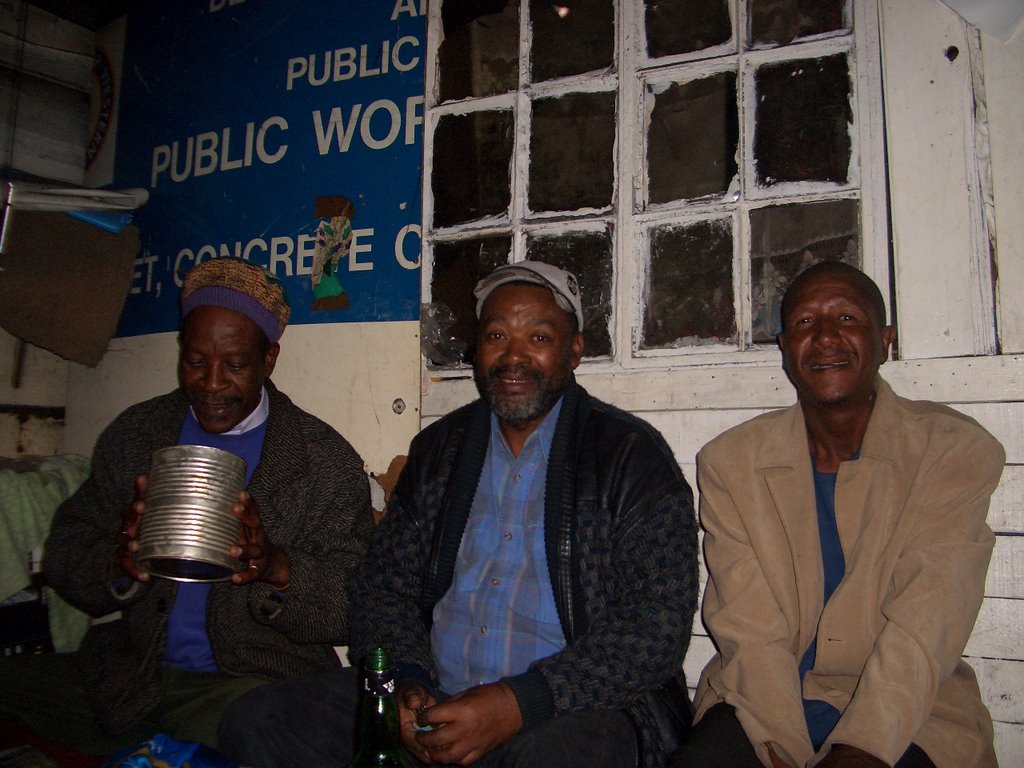
Don't worry I won't subject you to anything that long, title was figurative. In fact this will be very brief. Yesterday I had a chance to tour Langa again and take picture of the sites with Kenneth. I think the pictures are much more eloquent than I am so I will let them do the talking.


Kenneth and a friend with brewing beer.


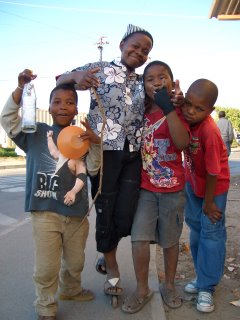


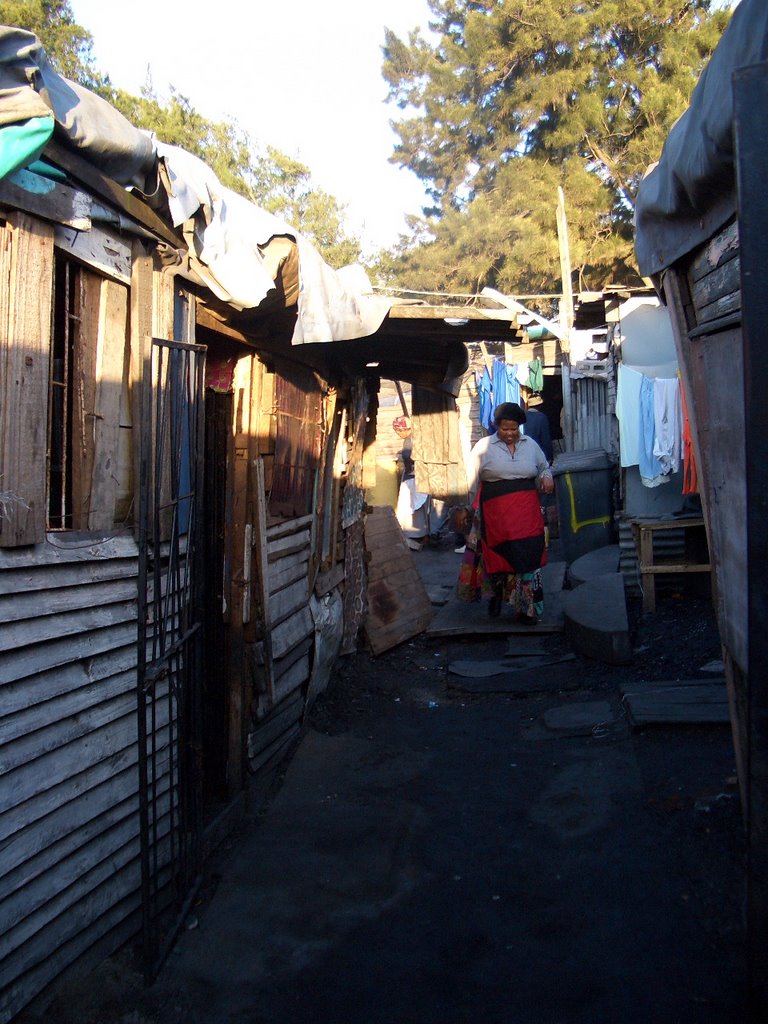

Kenneth and a friend with brewing beer.



Friday, June 09, 2006
Zimbabwe in Cape Town
America has the great luxury of having two huge Oceans isolating it from the strife of the developing world. South Africa, as the most developed nation in Africa is not so lucky. It faces massive unemployment, rising inequality that is even worse that the US (an impressive task), and rampant crime; all of these worse since the end of Apartheid. Meanwhile it has to deal with an influx of immigrants from even more impoverished nations hoping to fight for the bottom rung of the South African ladder. Because it is hard enough for South Africans themselves to get employed; unemployment is 40% (to put this in perspective, the peak of the Great Depression saw 25% unemployment), there seems to be much xenophobia and fear of immigration. Luckily this is nothing a soaring nation like America ever has to deal with.
Oh, wait.
More on that later. But I had first hand experience of this yesterday as I attended a chic Cape Town Press Club lunch with my family's good friend, Peter Soal. He invited me to this great event hosted at a beautiful hotel at the Baltimoresque V&A Waterfront, hardly Langa. Speaking was an asylum-seeking ex-opposition MP in Zimbabwe's Parliament, Roy Bennett. He had been thrown in jail and treated horrendously for bumping another MP from Mugabe (Zim's authoritarian "democratically elected" "President") party, ZANU-PF. It's probably not a coincidence Bennett has been extremely vocal in criticizing Mugabe.
After finally being released last year, he has been seeking asylum in South Africa because of his legitimate
fear of further persecution. Much to his (and the Press Club's) chagrin, he was denied asylum by the government. The reason for this is not the merits of his case. Instead, it seems it has to do with the precedent this would set for the two million or so refugees from Zimbabwe seeking asylum in South Africa.
During his speech, he made a impassioned plea for South Africa to stand up to Mugabe and not only open its warm womb of stability to not only himself but other Zimbabweans fleeing oppression. This was a plea well received by Cape Town's intelligentsia, myself excluded -- well not from the fact that I received it well...you get the point. To me it was great to hear about Zimbabwe -- a country I lived in for two years when I was a little tyke of about 6 or 7 -- first hand and it reminded me of how a country I had know only for its immense natural and human beauty had been driven into a ditch by Zimbabwe's ruling government.
Yet, what it also reminded me of was what I was told by a sweet old lady on a minibus to Langa: "All the countries in the world have so much to learn from each other." People often seem to think problems with immigration, poverty, education, unemployment and destructive regimes (I'm looking at you, Canada) are issues that only afflict one country in the world, their own. Yet, these are all issues countries across the globe struggle with despite nationalistic pleas insisting that each nation is an island, with nothing to learn from others.
I have a cheap pen bic pen in my hand right now.
The need for a writing instrument is a common affliction. There is a perfectly good reason why everyone in the world doesn't have to manufacture one for themselves. Yes, I know what you are thinking, heartless capitalist rational self-interest. Touche. But the point is that capitalism does the same thing that global citizenship does. It looks at our common problems and addresses them so that our common desires (be it cold hard cash or less human suffering) are met.
I'm not certain how to deal with immigration and instability issues be they in Mexico or Zimbabwe. Perhaps it has to do with recognizing the human cost of the immense poverty and instability. However, there this is not easy when your own country must deal with its own problems. Yet, being in a Catch-22 when you want to help other nations while simultaneously needing to provide for your own people is something every nation has in common.
When we pool our resources together and learn from each other as that sweet lady on the minibus suggested, it seems the pen is mightier than the sword.*
*Sorry, anyone that knows me certainly is aware that I can never resist a bad pun.
Oh, wait.
More on that later. But I had first hand experience of this yesterday as I attended a chic Cape Town Press Club lunch with my family's good friend, Peter Soal. He invited me to this great event hosted at a beautiful hotel at the Baltimoresque V&A Waterfront, hardly Langa. Speaking was an asylum-seeking ex-opposition MP in Zimbabwe's Parliament, Roy Bennett. He had been thrown in jail and treated horrendously for bumping another MP from Mugabe (Zim's authoritarian "democratically elected" "President") party, ZANU-PF. It's probably not a coincidence Bennett has been extremely vocal in criticizing Mugabe.
After finally being released last year, he has been seeking asylum in South Africa because of his legitimate
fear of further persecution. Much to his (and the Press Club's) chagrin, he was denied asylum by the government. The reason for this is not the merits of his case. Instead, it seems it has to do with the precedent this would set for the two million or so refugees from Zimbabwe seeking asylum in South Africa.
During his speech, he made a impassioned plea for South Africa to stand up to Mugabe and not only open its warm womb of stability to not only himself but other Zimbabweans fleeing oppression. This was a plea well received by Cape Town's intelligentsia, myself excluded -- well not from the fact that I received it well...you get the point. To me it was great to hear about Zimbabwe -- a country I lived in for two years when I was a little tyke of about 6 or 7 -- first hand and it reminded me of how a country I had know only for its immense natural and human beauty had been driven into a ditch by Zimbabwe's ruling government.
Yet, what it also reminded me of was what I was told by a sweet old lady on a minibus to Langa: "All the countries in the world have so much to learn from each other." People often seem to think problems with immigration, poverty, education, unemployment and destructive regimes (I'm looking at you, Canada) are issues that only afflict one country in the world, their own. Yet, these are all issues countries across the globe struggle with despite nationalistic pleas insisting that each nation is an island, with nothing to learn from others.
I have a cheap pen bic pen in my hand right now.
The need for a writing instrument is a common affliction. There is a perfectly good reason why everyone in the world doesn't have to manufacture one for themselves. Yes, I know what you are thinking, heartless capitalist rational self-interest. Touche. But the point is that capitalism does the same thing that global citizenship does. It looks at our common problems and addresses them so that our common desires (be it cold hard cash or less human suffering) are met.

I'm not certain how to deal with immigration and instability issues be they in Mexico or Zimbabwe. Perhaps it has to do with recognizing the human cost of the immense poverty and instability. However, there this is not easy when your own country must deal with its own problems. Yet, being in a Catch-22 when you want to help other nations while simultaneously needing to provide for your own people is something every nation has in common.
When we pool our resources together and learn from each other as that sweet lady on the minibus suggested, it seems the pen is mightier than the sword.*
*Sorry, anyone that knows me certainly is aware that I can never resist a bad pun.
Monday, June 05, 2006
"Adventure" on Table Mountain
Interesting fact: more people die every year on Table Mountain than on Mount Kilimanjaro. With that in mind, we began our trek up Table Mountain bright-eyed, bushy-tailed and full of energy, hope and fluids. We aimed to hike all the way up, approximate 2 1/2 hours according to the guide book. About a half hour into our journey, and as we glared at a sign post on the main trail, we ran into a hiker who appeared like he knew what he was doing . He had the hiker look going with the thick hiker socks, cut off t shirt and sunglasses which screamed "I know where I'm going". What's more, he casually and amicably asked us if we knew where we were going in a thick South African accent.
At this time, we were following the main path, which seemed clear enough. Yet we answered honestly that we didn't exactly know as none of us had hiked up Table Mountain before. Little did we know, answering him honestly was a poor decision.

Before we reached the sigh and that damn hiker, we saw the pictured sign which has a pretty clear message. Even men can follow those simple directions to stay out of Blinkwater Ravine. Little did we know that just a few hours later we would find ourselves going down that very ravine to try to save ourselves from, what I will euphemistically call, fertilizing a national park.
Alas, we made it back down to that sign and after much false hope on my part that we could make it up before sun down following the real trail, it was crushed by reality and we decided to head home. As we descended Table Mountain we were distraught, thirsty, tired and sore. We were only left by three small consolations.
First, I don't recall any of us saying we wanted to hike to the top of Table Mountain. As I recall, the semantics were "hike up" Table Mountain. Certainly, and I think you will agree, we had done that.
Second, we were certain that hiker who gave us horrendous directions would burn in the firey pits of hell.
Third, by the time we made it back down to the cable car station, we realized that any dignity or pride we wanted to salvage was heavily outweighed by our desire for some ice cold water.
So, we ended our journey with a SUCCESSFUL trek to a neighborhood supermarket, thankful to have our health and that "adventure" under our belts.
 1/2 hours according to the guide book. About a half hour into our journey, and as we glared at a sign post on the main trail, we ran into a hiker who appeared like he knew what he was doing . He had the hiker look going with the thick hiker socks, cut off t shirt and sunglasses which screamed "I know where I'm going". What's more, he casually and amicably asked us if we knew where we were going in a thick South African accent.
At this time, we were following the main path, which seemed clear enough. Yet we answered honestly that we didn't exactly know as none of us had hiked up Table Mountain before. Little did we know, answering him honestly was a poor decision.
"Oh, this way is much faster," he asserted as he pointed up the steep slope, away from the trail we were following, "the trail gets a little faint at times but its easy to follow."
Yeah, right.
About three hours later we ran into that sign post again, thankfully -- for the sake of his health -- he was nowhere to be seen. No, we had not made it up the mountain. Instead, we had spent hours trudging through prickly bushes, climbing up and down rock formations and bloodying ourselves as we tried -- and failed -- to make it up Table Mountain. Yeah, right.
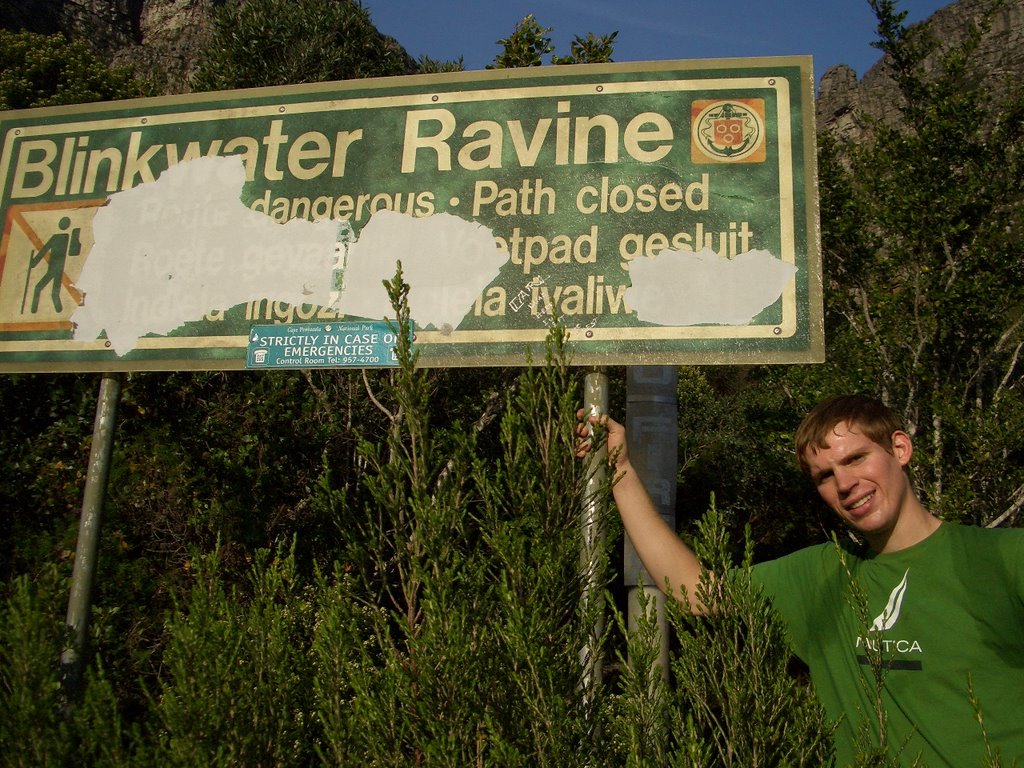
Before we reached the sigh and that damn hiker, we saw the pictured sign which has a pretty clear message. Even men can follow those simple directions to stay out of Blinkwater Ravine. Little did we know that just a few hours later we would find ourselves going down that very ravine to try to save ourselves from, what I will euphemistically call, fertilizing a national park.
Alas, we made it back down to that sign and after much false hope on my part that we could make it up before sun down following the real trail, it was crushed by reality and we decided to head home. As we descended Table Mountain we were distraught, thirsty, tired and sore. We were only left by three small consolations.
First, I don't recall any of us saying we wanted to hike to the top of Table Mountain. As I recall, the semantics were "hike up" Table Mountain. Certainly, and I think you will agree, we had done that.
Second, we were certain that hiker who gave us horrendous directions would burn in the firey pits of hell.
Third, by the time we made it back down to the cable car station, we realized that any dignity or pride we wanted to salvage was heavily outweighed by our desire for some ice cold water.
So, we ended our journey with a SUCCESSFUL trek to a neighborhood supermarket, thankful to have our health and that "adventure" under our belts.
Thursday, June 01, 2006
Turning Langa Inside-Out
Crossing the threshold of my home stay house in Langa, I had no idea what to expect. All of the township I'd seen before was the shanties, AKA informal settlements, that line the main highway from the airport into Cape Town Cape Town 

Having the opportunity to live in Langa allowed us to actually take the time to examine this footnote and really see how the poverty of wealth of township life shapes the way people think, act and live. Little did I know I would be thrown head first into this my second day in Langa.
Last Sunday, I met Kenneth a wirey man of 40, visibly aged to what seemed to be 55 by life with a big smile thrown off balance by a missing front-left tooth. He was firmly planted in a chair in my home stay living room as Cooper and I returned from church. I plopped down on the couch adjacent to it and introduced myself in broken, mispronounced Xhosa. As we got into a deeper discussion, he passionately told me about the changes in his country and how much hope he had for the younger generation.
The most notable moment of this conversation came as he stated that he thought
After hearing him say that he was a man of little means who simply worked odd jobs to stay alive, he offered me something that I will never forget, a chance to experience how people live in Langa. I accepted, slightly unsure what he meant. I certainly am glad I did. He took us all through Langa, from old apartments with 6 people living in 3 beds in 1 room to the new apartments the government is not building fast enough to, reluctantly, his own, dilapidated shanty to a dark, drab shebeen (informal bar rife with an African beer made of sorghum (however you spell that) and milk). It was an incredible, eye opening experience that I only now am beginning to process.
What made it so difficult to do so was not the dire poverty - I expected this. What made it so difficult to process was the stunning contraction between the absolute, bitter poverty and the amazing openness, magnanimity and friendliness of those I met, especially Kenneth.
Throughout our journey, I carried the baggage of being white. I was repeatedly approached for money, money that I could certainly afford to give away. However, Kenneth was our buffer, repeatedly telling those who approached us in isiXhosa that we were her to see, to experience and not to give. This gracious attitude pervaded as we approached his dull, one room shanty. We sensed his reluctance to show it to us, but he did so and invited into his shack consisting of a chair, a bed, and a small table with an oil lamp on it. This was an immensely emotional moment as I stared eye-to-eye with someone with twice the kindness, compassion, magnanimity that I will ever have yet without the very basic means of survival that I have come to take for granted, take as human essentials.
Yet, part of why this was so hard to process was the moment as he dropped us off at our home stay. As we were saying thank you and good bye, he quietly asked us if we could give him some money. I was happy to do so as he had given me a priceless experience, but this moment showed that despite his desire merely for us to learn, he had to eat too. This is something I certainly cannot fault him for.
The view of Langa I was given is not what most outsiders see. Yes they see the shacks. However they see them as inanimate objects lumped together as a "shanty town." They don't usually have the amazing opportunity to really see how people live, to really see how
Saturday, May 27, 2006
The End of the Beginning!
So the first part of our trip living in the comfortable reality-tv style house has come to an end. Soon I will be departing to my township homestay. There I'm staying with a single mother and her two kids, 24 and 15. I'm really excited to get to meet them and get immersed into REAL South African culture. Observatory, where our house is itself fairly westernied, I mean a few days go we got Mexican food. I don't know about you, but when I think of Africa, I don't think about Tacos.
There I will have a chance to work on my Xhosa, which is somewhere between horrible and horrendous. I'm hoping their interpret my desperate attempts to do the clicks correctly as me making an effort, not mocking them!
Smileys
n. A traditional African meal consisting of a boiled sheep's head served whole
These three weeks I'm going to do my best to be adventurous as I live and commute with Africans from Langa township on the outskirts of Cape Town. I will be making the trek into Cape Town each morning to my internship just as Africans were forced to do under Aprtheid migrant labor system.
Just about every part of my journey to the township is going to be a LITTLE outside my confort zone. Yet I need to make sure I make the extra effort to make myself that much more uncomfortable.
Wish me luck as I depart into the unknown and onto this next exciting stage of my adventure
Sobonana!
Friday, May 26, 2006
Fortuitousness?
This summer I am interning at the Catholic Parliamentary Office in Cape Town (CPLO). Its role is to mediate dialogue on issues of public policy between the government and the Catholic Church through forums, round tables and position papers. For those of you who know me, you might be wondering why someone like me, who is pretty secular (albeit spiritual), would take such a job. Well, the reason I chose to commit heresy on my atheist beliefs is because
They aren't overly concerned with political correctness, formality or – as that MP showed – status. These all contribute to the general relaxed attitude that I have repeatedly seen through their apparent disdain for schedules.
Tuesday, May 23, 2006
Welcome
Thank you for mistakenly clicking on my blog! I appreciate you taking time away from valuable pornographically themed browsing to read it.
I hope you enjoy hearing about my adventures in South Afirca throughout the summer (winter here!). Please let me know -- preferably through lengthy, spiteful diatribes -- what you think :)
I hope you enjoy hearing about my adventures in South Afirca throughout the summer (winter here!). Please let me know -- preferably through lengthy, spiteful diatribes -- what you think :)
Subscribe to:
Posts (Atom)